Cerakote News

NEWS
Cerakote Achieves Milestone: Passing H2S Autoclaving Tests for Oil and Gas Industry
Cerakote's success in the H2S autoclaving tests reaffirms its position as a high-performance coating
In a groundbreaking achievement, Cerakote, the industry-leading ceramic coating manufacturer, has successfully passed the H2S (Hydrogen Sulfide) autoclaving tests, setting a new standard for performance and reliability in the oil and gas sector.

NEWS
Cerakote® Achieves Outstanding Results in Federal Flammability Testing
Aircraft materials are expected to do more than perform during normal operation, they must also help be protective in the unlikely event of a fire.
That's why we're proud to announce that Cerakote H Series and F Series coatings successfully passed the 45° Vertical Flammability Test in accordance with 14 CFR 25.853(a), Amendment 25-116, Appendix F, Part I(a)(1)(i).

NEWS
CERAKOTE® Advanced Ceramic Coatings for Aerospace and Space Applications
Space presents some of the most demanding conditions for materials and surface protection.
From Low Earth Orbit (LEO) to deep space missions, spacecraft components must withstand exposure to atomic oxygen, extreme temperature fluctuations, UV radiation, vacuum conditions, and the risk of electrostatic discharge.

NEWS
Cerakote® Advances Aircraft Interior Safety with Successful Boeing BSS 7239 Toxicity Testing
Aircraft interiors are designed with one priority above all else: passenger safety.
This latest testing adds to Cerakote's growing portfolio of independently verified aerospace performance data, helping manufacturers specify coatings with confidence for demanding aviation applications.
NEWS
Cerakote® Introduces New Specialty Coatings Section for Advanced Performance Applications
The new section currently highlights Cerakote technologies engineered to address a range of specialized performance challenges.
From signature management and optical performance to electrical properties, extreme temperatures, and other demanding requirements, these specialty coatings demonstrate how a surface treatment can contribute directly to the performance of a component or system.

NEWS
Cerakote® Launches NEW Game-Changing F Series
F Series is the world’s best performing, PFAS free, thin film ceramic coating.
Engineered for high-volume production, F-Series is a two-part, oven cure coating applied directly to substrate. Its cutting-edge formulation features fast cure time and low temperature curing schedule.
NEWS
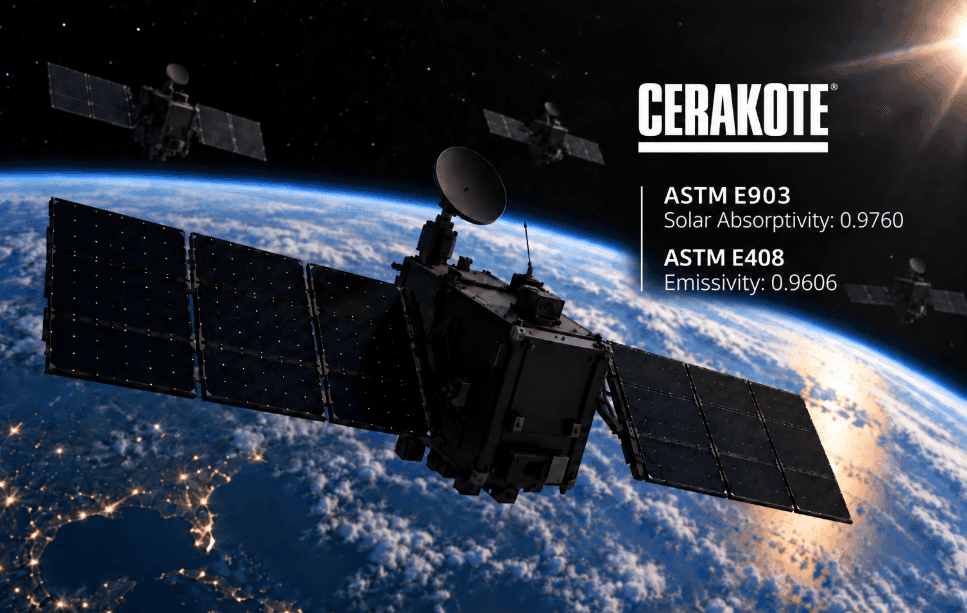
Cerakote® LR-200 Ultra Low Reflective Black Shows Strong Solar Absorptivity and Emissivity
CERAKOTE LR-200 was developed as an Ultra Low Reflective Black coating for applications where minimizing unwanted reflected light is critical.
These independently tested ASTM results provide additional performance data for engineers evaluating LR-200 for optical, aerospace and space applications.

NEWS
Cerakote® Passes Aerospace Heat Release Test With Flying Colors
The less heat a material releases, the less it contributes to fire growth, helping improve overall aircraft safety.
Unlike a simple flammability test that determines whether a material will ignite, the Heat Release Test measures how much energy a material contributes to a fire after ignition.

NEWS
Cerakote® PFAS-Free Coatings: High-Performance Protection Without Forever Chemicals
The coatings industry continues to evolve.
Our continued investment in coating technology is focused on solving difficult performance challenges while giving customers access to advanced chemistry designed for the requirements of modern manufacturing.

NEWS
Cerakote® Releases a New High Temp White That Stays White Up To 1,500°F
High-temperature coatings have traditionally required compromises in color selection or long-term appearance.
High Temp White gives customers another option: a durable ceramic finish that protects the underlying component while remaining clean and white under demanding operating conditions.

NEWS
Cerakote® Unveils LR-200: A Breakthrough in Ultra-Low Reflective Coatings for Aerospace and High-Performance Applications
In the aerospace industry, coatings play a critical role in managing thermal properties, minimizing light reflectivity, and ensuring material durability…
NEWS
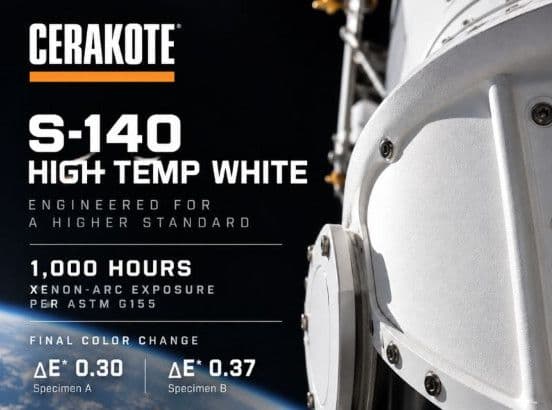
Cerakote's® High Temp White Passes the Difficult 1000 Hours Xenon-Arc Test (ASTM G155)
In space applications, coatings can be exposed to extreme environmental conditions where long-term stability matters.
Recent independent laboratory testing (Dallas Laboratories, Inc.) of Cerakote's® S-140 High Temp White demonstrated exceptional color stability after 1,000 hours of accelerated Xenon-Arc weathering exposure per ASTM G155.

NEWS
New from Cerakote®: Advanced Ceramic Dry Film Lubricant That Redefines Performance
Cerakote® is proud to introduce its latest innovation in high-performance surface coatings: a ceramic-based, PFAS-free Dry Film Lubricant engineered for…

NEWS
Not All Black Coatings Are Created Equal: The LR-200 Difference
When it comes to controlling light and reflectivity, the right black coating can make all the difference.
Developed for aerospace, optical, and space applications, Cerakote LR-200 delivers ultra-low reflectance of less than 3.5% across the visible and infrared spectrum.

NEWS
Why Cerakote® Excels on Cast Aluminum and Cast Magnesium
A properly specified ceramic coating can improve corrosion performance, extend service life, and reduce maintenance without adding significant weight or altering part geometry.